Research Leadership · Federal Funding · Technology Translation

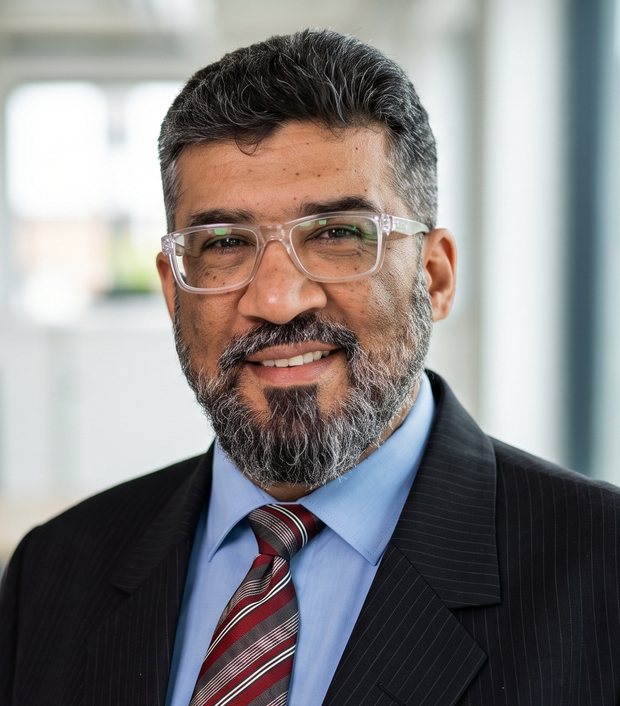
Samir Iqbal, PhD, PE

I have spent my career on both sides of the funding table. For four years I decided which early stage technologies received federal support. Before that, and since, I have built research programs and started companies out of my own laboratory.

Associate Dean for Research and Industry Partnerships, College of Computing, Grand Valley State University  ·  Former Program Director, U.S. National Science Foundation  ·  Fellow, Royal Society of Chemistry  ·  Licensed Professional Engineer

$177.6M
Federal portfolio managed at NSF
433
Awards decided
204
Institutions funded in 46 states
56
Startups funded via SBIR/STTR

About

Samir Iqbal

I have sat on all three sides of the table: the funder's, the founder's, and the reviewer's.

Four years deciding which early stage technologies the federal government would back, a decade building a research program before that, and two companies started out of my own laboratory.

I am Associate Dean for Research and Industry Partnerships in the College of Computing at Grand Valley State University, where annual research proposal submissions have grown by roughly an order of magnitude across two fiscal years. I played a major role in the $12.5 million Van Andel Institute agreement behind the university's first doctoral program, a PhD in AI for Life Sciences, and I am part of the team standing up its AI Research and Innovation Institute.

From 2021 to 2025 I served as a Program Director in the Directorate for Technology, Innovation and Partnerships at the U.S. National Science Foundation. I managed a portfolio exceeding $175 million across six programs at once, including SBIR/STTR, Partnerships for Innovation (PFI), Mid-Career Advancement (MCA), Open Source Ecosystems (POSE and Safe-OSE), and Accelerating Research Translation (ART). I built the Translation to Practice (TTP) program from concept through approved solicitation, chaired the working group that brought all eight NSF directorates to shared language, and negotiated the directorate's first co-funding agreements with the U.S. Army DEVCOM Ground Vehicle Systems Center and the Naval Surface Warfare Center at Dahlgren. I established TIP's first EPSCoR co-funding pathway, and I co-created APEX, the first NSF program to cover patent and intellectual property protection expenses for university researchers, which came from watching good academic technologies die for want of a few thousand dollars in patent costs.

Before Washington I spent a decade building a research program at the University of Texas at Arlington and chaired the Department of Electrical and Computer Engineering at UT Rio Grande Valley. My laboratory produced work in top-tier journals, issued U.S. patents, an NSF CAREER award, and two companies I co-founded as technical lead. I know what it costs to move something from a bench to a customer, because I have done it and I know where it goes wrong.

Consulting

Six ways I work with clients

I work with universities, deep tech startups, funders, and accelerators. Engagements are independent of my university role.

1. Federal Funding Strategy for Deep Tech

For startups and research teams pursuing NSF, SBIR/STTR, and translational funding.

I spent four years inside NSF making funding decisions on nearly 1,000 proposals across SBIR/STTR, PFI, Mid-Career Advancement, and Open Source Ecosystems. I also designed the TTP program from scratch, through to an approved solicitation. I know how proposals are actually read, what review panels reward, and where strong technologies fail on paper.

What you get: program fit assessment, proposal positioning and review before submission, guidance on supplement mechanisms most applicants never use, and a realistic funding roadmap from first award through private capital match.

2. Venture Readiness and Diligence Preparation

For deep tech startups preparing to face investors.

At NSF I conducted multistage, investment style due diligence on hundreds of early stage companies before federal awards: IP status and protection strategy, competitive landscape, team and equity structure, customer discovery readiness, commercialization pipeline, and budget integrity. That is the same review an investment committee runs before writing a check. I run it for you first.

What you get: a full diligence review before investors run theirs, identification of the gaps that kill deals, and preparation for the questions you will face in the room.

3. Founder Coaching for Academic Entrepreneurs

For researchers becoming founders.

I co-founded three ventures as technical lead, including two research grounded technology companies built directly from my laboratory. I have made the founder decisions that textbooks skip: IP strategy with incomplete information, first commercial hires, and the moment the data tells you something the business plan does not. Those companies taught me what actually kills early stage deep tech ventures.

What you get: honest, specific guidance on IP strategy, team formation, customer discovery, and the hard calls, from someone who has been at that table rather than read about it.

4. Research Translation and Commercialization for Universities

For research offices, colleges, and technology transfer units.

As Associate Dean for Research and Industry Partnerships I have helped grow annual research proposal submissions by roughly an order of magnitude across two fiscal years, founded a regional deep tech pitch competition reaching more than 50 teams and 300 attendees, and played a major role in a $12.5 million institute agreement behind a new doctoral program. Before that, my NSF portfolio produced 26 research grounded companies, and I funded 56 startups directly through SBIR and STTR.

What you get: design and launch of translation infrastructure, including pitch competitions, venture development programs, I-Corps pipelines, industry partnership strategy, and proposal pipeline construction.

5. Funding Program Design for Agencies and Foundations

For funders who want to build translation mechanisms, not just make grants.

At NSF I built the TTP program from concept to approved solicitation, led its working group across all eight NSF directorates, and negotiated the directorate's first co-funding agreements with the Army and Navy. I established TIP's first EPSCoR co-funding pathway, which went on to carry $6.7 million to institutions in eight EPSCoR jurisdictions, and I co-created new funding mechanisms including APEX, the first NSF program to fund patent and intellectual property protection expenses.

What you get: end to end program design, from concept and stakeholder alignment through solicitation language, review process architecture, expert panel recruitment, and partnership agreements.

6. Expert Review and Selection Committees

For accelerators, venture studios, prize competitions, and funders.

I organized more than 100 expert review panels at NSF, recruiting disciplinary experts across semiconductor materials, photonics, chemical technologies, data science, and environmental science. I have also served as a grant reviewer for funding agencies in five countries. I know how to build a review process that produces decisions you can defend.

What you get: cohort selection design, reviewer and judge recruitment, review criteria development, and independent expert evaluation of technical portfolios.

How I Work

I prepare you to face funders and investors yourself. I review your materials, sharpen your strategy, coach your team, and draft alongside you. You make the submission and hold the conversations.

That is deliberate. A founder who can defend the proposal in the room is worth more than a consultant who speaks for them, and it keeps every engagement cleanly within federal post-employment rules. I do not take engagements involving specific proposals or awards I handled during my NSF service.

Engagement models

Speaking and Advisory

I speak on research translation, federal funding strategy, deep tech commercialization, and building research capacity at institutions that are not starting from the top of the rankings.

Recent keynotes and invited talks include the ACM/IEEE International Conference on Model-Driven Engineering Languages and Systems, Tech Week Grand Rapids, the US-Taiwan Workshop on DeepTech Innovation and Partnerships in Taipei, the NSF Fall SBIR/STTR Innovation Conference in Austin, and a distinguished seminar at Kansas State University. I have twice served as an IEEE Distinguished Lecturer, for the Nanotechnology Council and for the Engineering in Medicine and Biology Society, and I have spoken at TEDx.

I founded and chair the Grand Rapids DeepTech Pitch Competition, and I chaired Innovation Tank, a Shark Tank style competition at the National Organization for the Professional Advancement of Black Chemists and Chemical Engineers annual conferences. I serve on the editorial boards of Nature Scientific Reports and three other journals, and I have reviewed grant proposals for funding agencies in five countries.

Research

My research career has been in nanoscale biosensors, solid state nanopores, and the electrical detection of cancer at the single cell level, with more recent work in AI applied to speech and to life sciences. The through line is building physical devices that detect something nobody could detect before, and then asking whether anyone outside the laboratory would use them.

That work has produced publications in Nature Nanotechnology, Biosensors and Bioelectronics, Nanoscale, Lab on a Chip, Applied Physics Letters, Biomedical Microdevices, Nanotechnology, and Scientific Reports, issued U.S. patents in nanoscale biosensing, an NSF CAREER award, and Fellowship in the Royal Society of Chemistry. I co-edited Nanopores: Sensing and Fundamental Biological Interactions for Springer. The current publication and citation record is on my Google Scholar profile.

I have supervised dozens of doctoral dissertations, master's theses, and undergraduate researchers, along with postdoctoral fellows and visiting sabbatical faculty, and I have served on doctoral and thesis committees at universities across the United States and internationally. Former students are now at Intel and GlobalFoundries and on university faculties. That part of the record matters more to me than the publication list.

Contact

Let us talk about what you are trying to build.

The best first step is a short call. Tell me what you are working on and what is in the way, and I will tell you honestly whether I am the right person for it.

Start a conversation